Why One-Shoulder Bags Wreck Your Neck by Gate B and How to Fix It
Quick Answer: A one-shoulder bag makes the muscles on that side contract continuously just to stop the strap sliding off, and continuous low-level contraction fatigues faster than heavy intermittent work. Three fixes, in order of payoff: switch sides every 10 minutes, use a wide strap worn crossbody, and get the total weight under roughly 10% of your bodyweight. The switching matters more than the weight.
Check-in: fine.
Security: fine.
Gate B: your neck is one solid line of tension from ear to shoulder blade.
It is not the weight. It is that one side never got a break.

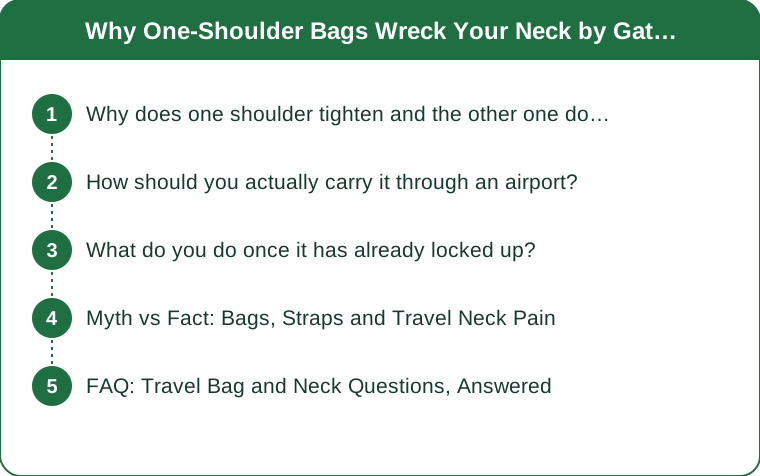
Why does one shoulder tighten and the other one doesn’t?
Five things happen on the loaded side that never happen on the free side.
Your shoulder elevates to hold the strap on. This is the big one. Keeping a strap from sliding off requires the upper trapezius to stay switched on the entire time you are walking. Continuous low-level muscle activity is unusually fatiguing — the same motor units stay recruited without rotation, so there is no chance to recover between contractions the way there is in normal walking.
Your torso side-bends away from the load. Carrying weight on the right means leaning left to keep your centre of mass over your feet. That lean is held by muscles down the opposite side of your trunk, which is why the ache sometimes shows up on the unloaded side of your low back.
Your arm stops swinging. Walking with one arm pinned to your body to steady a bag removes the counter-rotation that normally lets your thoracic spine move with each step. Twenty minutes of that and the mid-back stiffens up on its own.
Head position drifts. People carrying an asymmetric load tend to tilt the head slightly toward the loaded side. Even a small sustained tilt increases load on the neck extensors considerably, because your head is heavy and leverage is unforgiving.
And you never notice until you stop. Continuous contraction produces a slow build with no sharp signal. The pain arrives when you finally set the bag down and the muscle tries to lengthen again.
How should you actually carry it through an airport?
Five changes, roughly in order of how much they help.
Switch sides every 10 minutes, not when it starts hurting. By the time it hurts you have already accumulated the fatigue. Set the interval — gate change, moving walkway, every time you check the departure board — and swap on that cue instead of on symptoms. This single habit does more than any bag upgrade.
Wear it crossbody, not on one shoulder. Crossbody removes the shoulder-elevation problem entirely, because the strap cannot slide off, so the trapezius stops working overtime. The trade is a diagonal pressure line across your chest — worth it for the sustained walking sections, and easy to reposition when you sit.
Get a wider strap. A 5cm (2 inch) or wider strap spreads the same load over more tissue and drops the peak pressure meaningfully. Thin decorative straps concentrate everything onto one narrow band right where the nerve and vessel bundle sits, which is why they cause tingling down the arm.
Aim for under 10% of your bodyweight in the shoulder bag. For a 60kg traveller that is about 6kg. Above that, no strap or technique rescues you across a long terminal walk — the load simply needs wheels.
Put the heavy things low and close. Weight sitting high in a tote swings and pulls; weight low and against your body has a shorter lever arm and stays put. Laptop against your back, water bottle at the bottom, not the reverse.

What do you do once it has already locked up?
Five things that work in an airport, standing, without a mat.
Set the bag down and do slow shoulder rolls. Ten backwards, unhurried. The point is to move the joint through range after 40 minutes of it being held still, not to stretch anything hard.
Do a doorway or pillar chest opener for 30 seconds a side. Forearm on the surface, elbow at shoulder height, turn your body away. The front of the shoulder shortens under a bag strap, and opening it lets the upper back settle back down.
Add a gentle neck side-bend, 20 seconds each way. Ear toward shoulder, opposite hand relaxed at your side. Do not pull hard. Sustained-contraction fatigue responds better to gentle repeated movement than to aggressive stretching.
Walk two minutes with both arms swinging freely. Bagless if you can — park it by your travel companion or set it on your bag if you have a wheeled case. Restoring arm swing unwinds the thoracic stiffness surprisingly quickly.
Then use the flight. Sitting still for hours after a one-sided load is what turns tightness into a two-day problem. Every hour, do ten shoulder rolls and a seated twist. Ninety seconds, and it changes how you feel at baggage claim.
Myth vs Fact: Bags, Straps and Travel Neck Pain
Myth: heavier bags cause more neck pain. Fact: duration and asymmetry matter more than weight for this specific problem. A light bag carried on one side for 45 minutes beats up your neck more than a heavier one switched every 10.
Myth: backpacks are always better. Fact: a backpack worn on both straps is much better. Worn slung over one shoulder — which is what most people actually do — it is worse than a proper crossbody, because the strap is narrow and the load sits further from your body.
Myth: a padded strap fixes everything. Fact: padding helps with pressure but does nothing about shoulder elevation. Width and crossbody positioning matter more than padding.
Myth: you should stretch it out hard when it tightens. Fact: aggressive stretching of a muscle that has been contracting continuously for an hour often makes it more irritable. Gentle range-of-motion beats intense stretching here.
Myth: compression sleeves or posture braces solve it. Fact: nothing passive changes the fact that one side is loaded and the other is not. Switching sides is the mechanism-level fix.
Myth: it’s just an airport problem. Fact: the same pattern shows up with a laptop bag on a commute, a nappy bag, a camera strap. Airports just concentrate 40 unbroken minutes of walking into one go.
FAQ: Travel Bag and Neck Questions, Answered
How often should I switch shoulders?
Every 10 minutes, on a cue rather than on pain. Waiting until it aches means the fatigue has already built.
Is crossbody genuinely better than one shoulder?
Yes, for sustained walking. It removes the need to keep the shoulder elevated, which is the main driver of the tightness.
How heavy is too heavy for a shoulder bag?
Roughly 10% of your bodyweight as an upper limit for a terminal walk. Above that, use a wheeled bag for the transit and keep only essentials on your shoulder.
Why does my arm tingle when I carry my tote?
A narrow strap concentrating pressure at the top of the shoulder can irritate the nerve and vessel structures that pass through there. Widen the strap, lighten the load, and switch sides. Tingling that persists after you set the bag down is worth getting looked at.
Does a backpack fix the problem?
On both straps, largely yes. On one strap, no — that is just a worse shoulder bag.
What about on the plane itself?
Sitting still for hours locks in the tightness. Shoulder rolls and a seated twist once an hour make a real difference to how you feel on arrival.
Should I do anything before I travel?
If you already know one side is your problem side, a few sets of rows and carries in the week beforehand build the endurance that continuous carrying demands. This is general information, not medical advice — persistent or worsening neck pain deserves a professional opinion.
TL;DR:
- One-shoulder bags force continuous contraction to stop the strap sliding — that, not the weight, causes the ache.
- Switch sides every 10 minutes on a cue, not when it starts hurting.
- Crossbody plus a 5cm-wide strap removes most of the problem; keep the bag under 10% of bodyweight.
- Once tight, use gentle movement — shoulder rolls, chest opener, restored arm swing — not hard stretching.
- Move once an hour on the flight, or terminal tightness becomes two-day tightness.
Try the 10-minute switch on your next trip. It is the rare travel fix that costs nothing and works immediately.
Keep Reading
This article is for general informational and styling purposes only. Fit, sizing, and product availability may vary.