Why the Last Night of a Trip Is Often Worse Than the Middle Ones
Quick Answer: The first night is bad because half your brain stays on watch in an unfamiliar room. The last night is bad for a different reason — anticipatory wakefulness before an early alarm. Knowing you must wake at 4:30 raises cortisol in the hours before waking and fragments the second half of the night. The fix is to remove the uncertainty: pack the night before, set two alarms, and stop calculating the departure timeline in bed.
Night one is famously rough and everyone expects it. Nights two and three settle. Then the last night is somehow worse than any of them, and nobody warns you about that one.
It is not the bed. You have slept in it three times already.

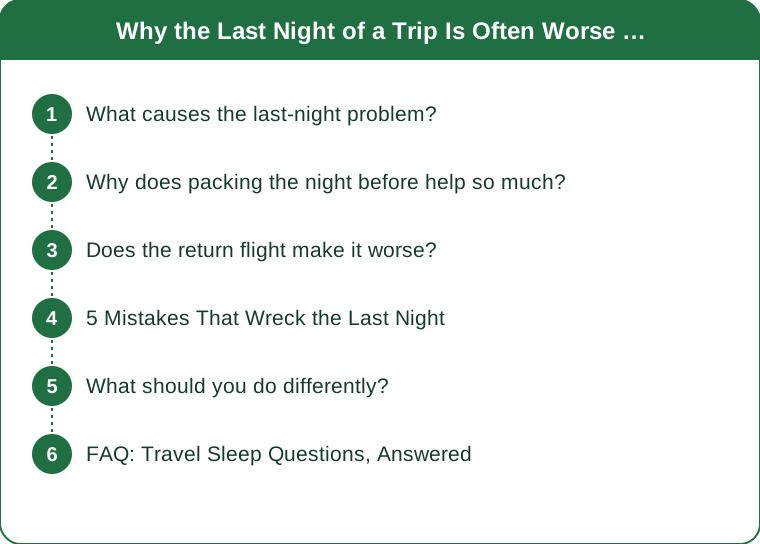
What causes the last-night problem?
Two mechanisms, and neither is the same as the first-night effect.
Anticipatory cortisol. When you know you have to wake early, your body begins the waking process ahead of the alarm. Research on anticipated wake times has shown a rise in adrenocorticotropic hormone in the hour or so before an expected early waking that does not occur before a normal one. Your system is preparing for the alarm, and that preparation fragments the last part of your sleep.
Vigilance about missing it. Distinct from the hormonal response, this is the conscious loop — checking the time, mentally rehearsing the taxi, the check-in, the security queue. Every check resets your sleep latency and pulls you back toward wakefulness.
The first-night effect is your brain monitoring a strange environment. The last-night effect is your brain monitoring a deadline. Different causes, different fixes, and the fixes for one do nothing for the other.
Why does packing the night before help so much?
Because most of the vigilance loop is about unresolved tasks, and an unresolved task is what keeps a brain in a low-level planning state.
Specifically:
- Packing removes the largest open item. A packed bag by the door converts will I have time in the morning into a settled fact.
- Laying out clothes removes a decision. Small, but decisions in the morning create anticipation the night before.
- Checking in online and downloading the boarding pass removes the biggest source of what-ifs.
- Writing down the departure time and the buffer gets it out of your head. Anything you are trying to remember, you are actively rehearsing.
The pattern behind all four is the same: the loop runs on uncertainty, so eliminate the uncertainty rather than trying to stop the loop. Telling yourself to stop thinking about the alarm is famously ineffective.
Does the return flight make it worse?
Yes, and this is why the journey home so often feels harder than the outbound even when it is the same length.
You arrive at the return flight with:
- Accumulated sleep debt from several nights of travel-quality sleep
- A fragmented final night from the mechanism above
- An early departure more often than on the way out, because return flights tend to be booked for the earliest slot
- No anticipation to carry you — the outbound has excitement doing some of the work, and the return has none
That combination is why day one back home is usually the worst day of the whole trip. It is not just time zones, and it happens on trips with no time change at all.
If the trip is short and you have any flexibility, a mid-morning return flight rather than a dawn one is worth more than most travel upgrades.

5 Mistakes That Wreck the Last Night
1. Leaving packing until morning. The single biggest one. Even a partial pack the night before removes most of the loop.
2. Setting one alarm. One alarm requires trust; two alarms remove the need for it. Set a backup on a different device and stop checking.
3. A late final dinner. The celebratory last-night meal is usually later, larger, and often includes alcohol — which fragments the second half of sleep exactly where the anticipatory effect is already doing damage.
4. Calculating the timeline in bed. If you catch yourself working out when to leave for the airport, get up, write it down, then go back. Two minutes of getting up beats forty minutes of rehearsing.
5. Trying to sleep earlier than usual. Going to bed two hours early to compensate typically produces two hours of lying awake, which adds frustration to the pile. Go at close to your normal time and accept a shorter night.
What should you do differently?
A short checklist for the last evening:
- Pack fully before dinner, not after. Bag closed, by the door.
- Check in online and screenshot the boarding pass. Screenshot, so it works with no signal.
- Write the morning timeline on paper. Leave at 5:15, taxi booked, passport in the front pocket. Then put it face down.
- Set two alarms on two devices.
- Keep alcohol light. The last-night drink costs more than any other night’s drink.
- Go to bed at close to your normal time.
And on the travel day itself: accept that you slept badly and plan around it rather than pushing through. Do not schedule anything requiring judgment for the evening you land. Day-after-travel is the most reliably impaired day of any trip, and treating it as a normal working day is how a good trip ends badly.
FAQ: Travel Sleep Questions, Answered
Is the first-night effect the same thing?
No. The first-night effect is a well-documented phenomenon in which one brain hemisphere maintains lighter sleep in an unfamiliar environment — a vigilance response to a new place. The last-night problem is anticipation of an event. They feel similar and respond to completely different interventions.
Does a sleep aid help on the last night?
It can, but timing is the risk — most sleep aids have a duration that overlaps an early alarm and leaves you groggy through the airport. If you use anything, use it early enough that its effect has faded by the alarm, and discuss it with a pharmacist or doctor rather than improvising on a trip.
Why do I sleep fine before a normal early morning at home?
Because your home routine is automatic and nothing is unresolved. There is no packing, no unfamiliar journey, no missing-the-flight consequence. Anticipatory wakefulness scales with the cost of getting it wrong, and missing a flight is expensive in a way that being late to the office is not.
TL;DR:
- The last night fails from anticipatory wakefulness before an early alarm, not from an unfamiliar room.
- The vigilance loop runs on unresolved tasks — pack before dinner, check in online, write the timeline down.
- Two alarms remove the need to trust one, which removes the checking.
- The return journey stacks sleep debt, a fragmented last night, and an early departure, which is why arriving home feels worst.
Pack before dinner on your last evening. It sounds trivial and it is the whole fix.
Keep Reading
This article is for general informational and styling purposes only. Fit, sizing, and product availability may vary.