Why the Workout Clothes in Your Suitcase Never Get Worn
Quick Answer: Unworn travel workout clothes are a friction problem. Kit buried under folded clothes, split across compartments, or requiring three decisions before you can leave the room loses to the easier option every time. Packing one complete outfit as a single grab-and-go unit at the top of the bag is what changes the behavior, not more motivation.
Every trip you pack the leggings, the sports bra, the top, and the shoes. Every trip they come home unworn and take up the space that could have held the sweater you actually wanted.
You have concluded that you are not the kind of person who works out while traveling. Try a different explanation: the kit was six decisions and two minutes of digging away, and the trip was already crowded.
Why does travel beat an otherwise solid habit?
Because habits are held up by cues and low friction, and travel removes both at the same time.
At home, your workout happens because a specific thing prompts it and the barrier is nearly zero. The kit is in a known drawer, the route out of the door is automatic, and the time slot is defended by everything around it.
Travel deletes every cue. Different room, different morning order, different noise, no familiar drawer. The behavior was never really powered by motivation, so removing the scaffolding removes the behavior.
And it multiplies the decisions. At home, working out is one decision. In a hotel it is: what will I do, where, is the gym open, do I need a key card, what do I wear, where is the kit, will I have time to shower before checkout. Seven decisions, all before you have moved.
Travel days also carry a real fatigue cost that people discount. Sitting for hours, disrupted sleep, dehydration from cabin air, and an altered schedule all reduce the energy available for anything optional.
Plus the trip has a purpose that is not you. Work trips have meetings, family trips have family, holidays have plans made by other people. The workout is the only item on the itinerary with no external accountability, so it is the one that gets dropped.
Understanding this matters because it points at the fix. You cannot import your cues. You can remove almost all of the friction.
What does packing for actual use look like?
One complete unit, at the top, with no decisions left inside it.
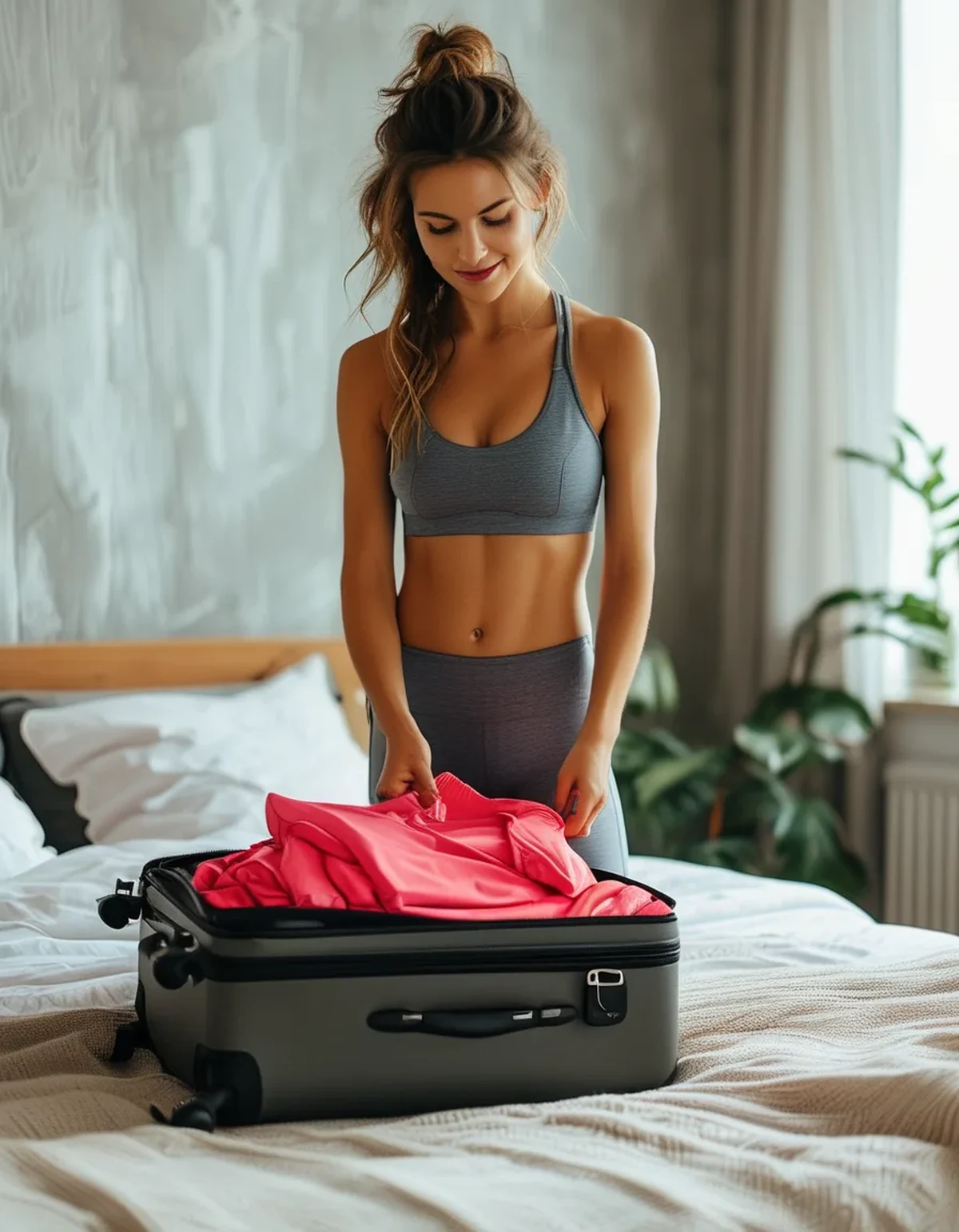
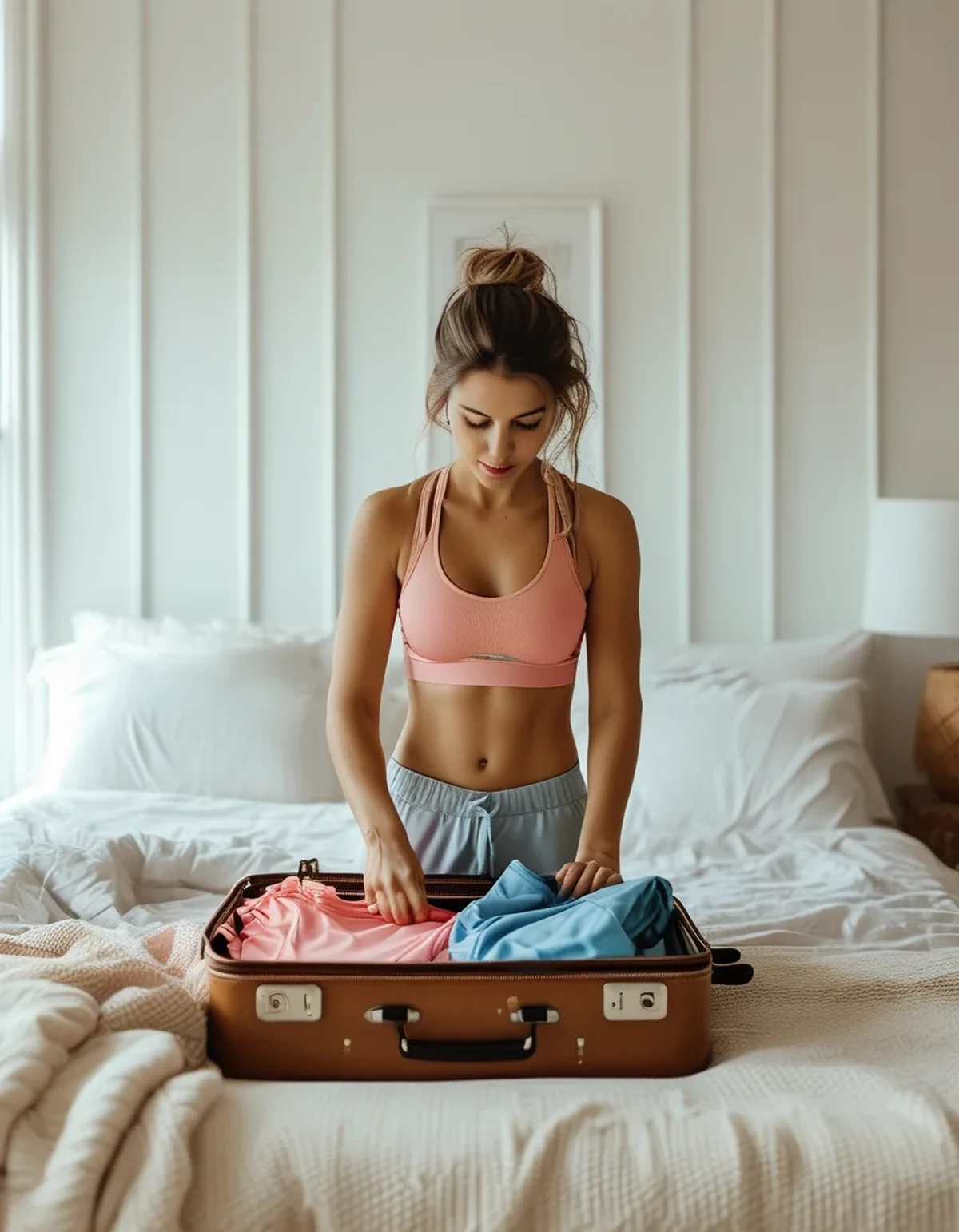
Pack one full outfit together as a single bundle, rolled or in one small pouch: bra, bottoms, top, socks. Not distributed among your other clothes. The bundle is the whole intervention - it converts a search into a grab.
Put it at the top of the bag or in the outer pocket. Whatever you have to unpack to reach it is the tax on doing it, and the tax needs to be zero.
Pack one outfit, not four. Counterintuitively, packing less increases use. Four sets create a choice, and a choice at six in the morning in an unfamiliar room is a place where the plan dies. One set means the decision is already made, and it can be rinsed in the sink if needed.
Choose the shoes you can also walk in. A shoe that only works for the gym is a shoe carried for a single use. A neutral trainer that handles a long day of walking, a hotel treadmill, and dinner is the one that earns its space.
Include a resistance band. It weighs almost nothing, removes the dependency on a hotel gym entirely, and makes a workout possible in a room with the curtains shut and no equipment.
Skip the extras that need context. Yoga mat, foam roller, and dedicated shoes are the items most likely to come home untouched. The hotel towel is a workable mat.
The target is that you can be dressed and moving within ninety seconds of deciding to, without unpacking anything.
5 Mistakes That Guarantee Unworn Kit
1. Packing for your best self rather than your realistic self. Kit for five workouts on a four-day work trip is a fantasy about a version of you who is not the one taking this trip. Pack for one or two, and be pleased if you exceed it.
2. Splitting the outfit across the bag. Bra in one packing cube, leggings in another, top folded in with the shirts. Now working out requires three retrievals. This is the single most common version of the problem.
3. Assuming the hotel gym is a plan. Hotel gyms are often small, sometimes closed, occasionally full at exactly the hour you have free, and in some places require a key card you have to ask for at the desk. A plan that requires an unfamiliar facility to cooperate is a fragile plan. Have a room-based fallback and the gym becomes a bonus.
4. Scheduling it for the end of the day. Evening workouts on a trip lose to dinner, drinks, colleagues, delays, and tiredness, in that order. Morning is not better because mornings are magical - it is better because nothing has had a chance to move yet.
5. Treating a short session as not worth doing. Twenty minutes in a hotel room keeps the thread of the habit intact, and the thread is the actual asset. The all-or-nothing framing is what turns one skipped day into a skipped trip and then a skipped fortnight.
The theme is the same across all five: every one of them adds either a decision or a dependency.
What actually works once you are there?
Lower the bar, fix the time, and use what is already in the room.
Decide the night before, specifically. Not I will work out tomorrow, but at seven, in the room, twenty minutes, bodyweight circuit. Vague intentions do not survive an unfamiliar morning.
Lay the kit out before you sleep. The hotel version of putting your running shoes by the door. It is a small piece of theater and it works.
Have a default twenty-minute session you never have to design. Something like squats, push-ups, lunges, plank, and a hip hinge, three rounds, minimal rest - the specific movements matter far less than not having to invent them while jet-lagged. Adjust rounds to the time available.
Count walking properly. A long walk in a new city is genuine activity and often more of it than your home routine produces. Treating it as real, rather than as not-a-workout, keeps the habit’s continuity and makes the trip better.
Use the stairs deliberately when the hotel has them and it is safe to do so - a few flights done as intervals is a legitimate session and requires nothing at all.
And accept the trip’s actual shape. A conference with sessions from eight to seven has no workout in it and pretending otherwise just produces guilt. Two of four days is a good result on most trips.
One thing worth adding as the seasons change: late-summer trips often have a genuine heat problem in the middle of the day, and the cooler early morning is not just habit-friendly but physically easier. As autumn arrives, that same early slot gets dark, so a room-based session with a band becomes the more reliable default than an outdoor run in an unfamiliar area.
FAQ: Travel Workout Questions, Answered
Is it worth packing kit for a two-night trip?
One rolled outfit at the top of the bag, yes - it costs almost no space. A separate pair of gym shoes for two nights, usually not.
How do I handle the laundry problem on longer trips?
One set, rinsed in the sink with hotel shampoo and hung overnight. Modern activewear dries fast, and it is why one set beats four. Wring it in a towel first and it dries considerably quicker.
What if the room is too small to work out in?
Most bodyweight work needs about the footprint of a bath towel. Standing movements, a plank, and band work all fit in the space at the end of a bed. If the floor is genuinely unusable, stairs and a brisk walk cover it.
Should I try to keep my normal program while traveling?
Almost never. Trying to replicate a structured gym program in a hotel produces a bad version of it and usually nothing at all. Switch to maintenance - short, simple, frequent - and pick the program back up at home.
TL;DR:
- Unworn travel kit is a friction problem, not a willpower one - travel removes your cues and multiplies the decisions at the same time.
- Pack one complete outfit as a single bundle at the top of the bag, plus a resistance band and shoes you would also walk in.
- Packing fewer sets increases use, because one set removes the morning decision entirely.
- Decide the specific time the night before, keep a default twenty-minute session you never have to design, and count long walks as real.
You are not the person who does not work out while traveling. You are the person whose leggings were under four folded shirts.
See It in Motion
Seen here: High Waist Embossed Yoga Leggings with Side Pockets — shop it on bubblelime.com
Keep Reading
This article is for general informational and styling purposes only. Fit, sizing, and product availability may vary.