Why the First Night in a Hotel Is Always the Worst — and How to Blunt It
Quick Answer: Sleep researchers call it the first-night effect — in an unfamiliar place, one brain hemisphere stays measurably more vigilant than the other, producing lighter sleep and more awakenings. It is a surveillance response, not a comfort problem. You cannot switch it off, but you can shorten it by making the room read as familiar: your own pillowcase, a consistent pre-bed sequence, darkness, and cool air.
The bed is nicer than yours. The room is quiet. You are exhausted.
And you are awake at 2:40am, then again at 4:15, and the second night in the exact same room is fine.
Nothing about the room changed. Your brain finished deciding it was safe.
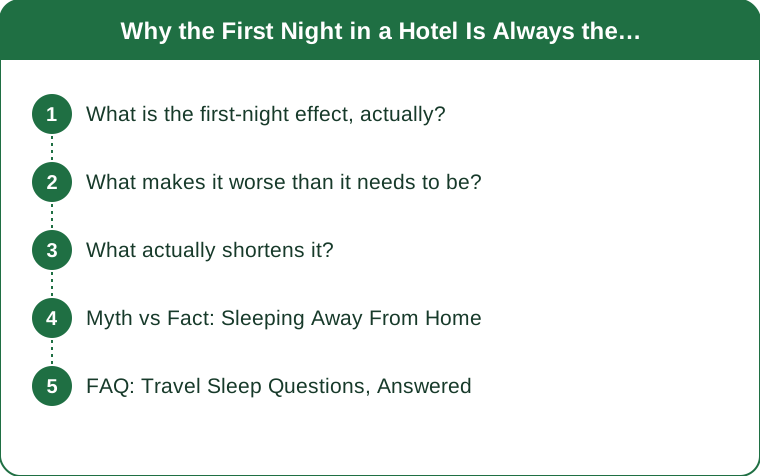
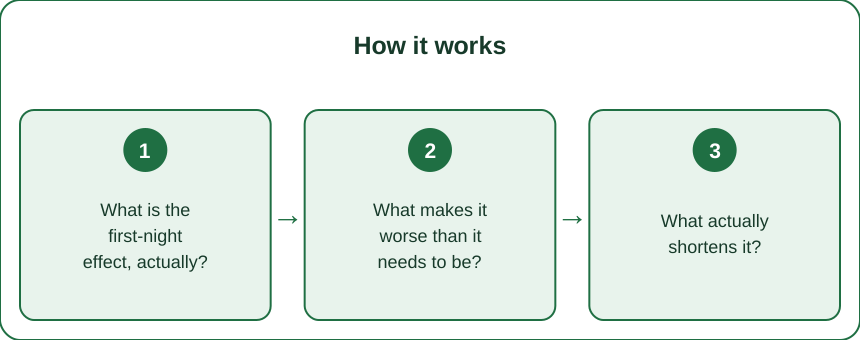
What is the first-night effect, actually?
It is a documented asymmetry in how your brain sleeps somewhere new.
Sleep lab studies have found that on a first night in an unfamiliar environment, one hemisphere shows shallower deep sleep than the other and responds more strongly to sounds. Researchers describe it as a night-watch function — part of the brain staying partially on duty in a place it has not yet cleared.
This is why the pattern is so specific. It is not that you cannot fall asleep; most people fall asleep fine. It is that you wake more often, spend less time in deep sleep, and wake up feeling like you were awake more than you were.
It also explains the thing everyone notices: night two is better. The vigilance response fades once the environment has been sampled without incident. In most people the effect largely resolves by the second or third night, which is precisely when a three-night trip ends.
Worth naming: this is normal and it happens to people with excellent sleep. It is not insomnia and it is not something wrong with you.
What makes it worse than it needs to be?
A handful of specific, fixable things, most of which are about unpredictability rather than comfort.
Unpredictable noise. Your brain is on watch for novel sounds, and hotels are full of them — hallway doors, elevators, HVAC cycling, a neighbor’s TV. It is not the loudness, it is the irregularity. A constant sound is easier to sleep through than an occasional one.
Light leaks. Hotel blackout curtains almost never meet in the middle, and there is usually a bright standby LED on something. Light is the strongest circadian signal there is, and a strip of hallway light across the bed matters more than the mattress firmness.
Temperature. Hotel rooms are commonly kept warmer than a good sleeping temperature, which sits around 65 to 68°F for most people. Warm rooms fragment sleep independently of everything else.
The novelty of the routine itself. If you normally read for twenty minutes and instead you scroll in an unfamiliar bed, you have removed the strongest cue your body has that sleep is coming.
Arrival timing. Late check-in means you go from stimulation straight to lights-out with no wind-down, in a room you have not had time to habituate to. An hour in the room before bed is genuinely worth more than an extra hour of sleep opportunity.
What actually shortens it?
Make the new room resemble your old one on the dimensions your nervous system checks.
Bring your own pillowcase. This sounds trivial and is one of the most consistently reported travel-sleep tricks. Smell is processed in close proximity to memory and emotional centers, and a familiar-smelling pillow is a strong safety cue. It weighs nothing.
Run a constant sound. A white-noise app, a fan, or the bathroom vent turns unpredictable noise into predictable noise. This is the single highest-impact fix for hotel sleep.
Fix the light before you get in bed. Use the trouser hanger with clips from the closet to pin the curtains together — it works perfectly and it is in every hotel room. Cover or unplug standby LEDs, and put a towel along the base of the door if the hallway is bright.
Set the room to 66°F on arrival, not at bedtime. Rooms take time to cool, and going to bed in a room still equilibrating means waking at 3am too warm.
Keep the pre-bed sequence identical. Same order, same duration, same activities as at home, even compressed. The sequence is the cue; the location is not.
Get morning light at the destination. This does nothing for the first-night effect directly, but if you have crossed time zones it is the fastest way to move your clock, and jet lag stacked on top of a first night is what makes people miserable on day two.
Myth vs Fact: Sleeping Away From Home
Myth: A better mattress means better sleep in a hotel. Fact: Mattress quality has surprisingly little to do with the first-night effect. Unfamiliarity is the variable, which is why people sleep badly in a luxury suite and well on a friend’s sofa they have used before.
Myth: Alcohol helps you sleep on the first night. Fact: It shortens sleep onset and then fragments the second half of the night, which is already the fragmented part. It reliably makes the first-night pattern worse.
Myth: You should sleep in as long as possible to catch up. Fact: On a trip, a fixed wake time and morning light get you to normal faster. Sleeping in delays adaptation and makes night two later, not better.
Myth: Melatonin fixes hotel sleep. Fact: Melatonin is a circadian timing tool, useful for time-zone shifts at low doses. It does not address a vigilance response, and it will not stop you waking at 3am in a room your brain has not cleared.
Myth: Frequent travelers do not experience it. Fact: They experience it less, largely because their routines are more portable and hotel rooms are less novel to them. The effect diminishes with familiarity, not with willpower.
FAQ: Travel Sleep Questions, Answered
Does it happen in an Airbnb or at a relative’s house too?
Yes — the effect is about environmental novelty, not hotels specifically. A relative’s spare room can be worse, because it often has less light control and more unpredictable household noise.
How long before it goes away?
For most people the majority of it is gone by night two, and largely resolved by night three. Returning to the same hotel you have stayed in before shortens it further.
Is one bad night worth worrying about?
No. A single fragmented night has modest effects on next-day function, and worrying about it reliably makes the following night worse. Plan the important meeting for day two if you can, and let night one be what it is.
What is the one thing to pack?
Earplugs or a white-noise source. If you only fix one variable, fix the unpredictable-sound one — it addresses the exact mechanism keeping half your brain on watch.
TL;DR:
- The first-night effect is a real, measured vigilance response — one hemisphere sleeps lighter in an unfamiliar room.
- It causes more awakenings, not trouble falling asleep, and it mostly resolves by night two.
- Blunt it by making the room familiar: your own pillowcase, constant sound, real darkness, 66°F, identical pre-bed sequence.
- Use the closet clip hanger to shut the curtain gap, and set the temperature on arrival rather than at bedtime.
The mattress was never the issue. Part of your brain was standing guard, and it just needed one uneventful night to stand down.
Keep Reading
This article is for general informational and styling purposes only. Fit, sizing, and product availability may vary.