Why Your First Run in a New City Always Feels Terrible
Quick Answer: The first run in a new place feels disproportionately hard because five variables shift simultaneously: circadian disruption from travel, dehydration from flying, unfamiliar terrain and elevation, different heat and humidity, and the cognitive load of navigating while running. None of these are fitness. Running easy for the first session, hydrating deliberately before you go, choosing an out-and-back on a simple route, and postponing any hard effort to day three fixes almost all of it.
You land, you’re excited, you lace up the next morning, and four kilometers in you feel like you’ve never run before. You had a great week of training at home. Nothing has actually gone wrong.

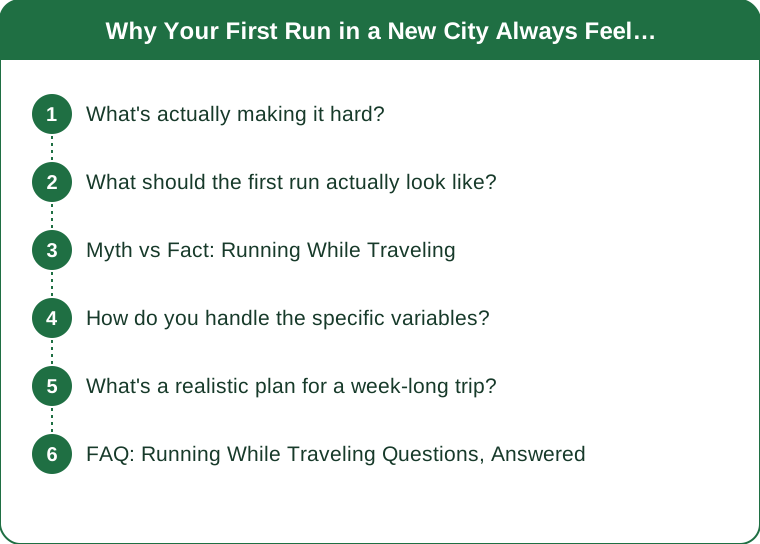
What’s actually making it hard?
Five things, stacked, and they’re additive.
1. Circadian disruption. Even without crossing time zones, travel disrupts sleep timing and quality. Your body’s temperature rhythm, hormone release, and perceived exertion all follow a daily cycle. Running at 7am local time after a red-eye means running at what your body thinks is 2am, and performance at that internal hour is genuinely lower.
2. Dehydration. Cabin air is extremely dry — commonly cited relative humidity in flight is under 20 percent, compared to 40 to 60 percent indoors at home. Combined with reduced drinking and often more alcohol or coffee than usual, most people land measurably dehydrated. Even mild dehydration meaningfully increases perceived effort and heart rate at a given pace.
3. Different terrain and elevation. A city with hills when you train on flats is a different workout. Any elevation above roughly 4,000 feet reduces oxygen availability enough to be noticeable, and cities like Denver, Mexico City, or Bogotá will humble a sea-level runner immediately.
4. Heat and humidity change. Moving from a dry 60°F to a humid 80°F is a substantial physiological change, and heat acclimatization takes 7 to 14 days. Humidity in particular impairs evaporative cooling and raises heart rate at any given pace.
5. Navigation load. Running while checking a map, watching traffic, and reading unfamiliar signage is cognitively expensive and it breaks rhythm. You stop, you restart, you hesitate at intersections — none of which appears on your watch but all of which costs you.
And a sixth that people forget: sitting for hours stiffens hips and calves. The first run is often on tissue that hasn’t moved properly in a day.
What should the first run actually look like?
Deliberately easy, deliberately simple, and shorter than you planned.
Run by effort, not by pace or distance. Whatever your easy effort feels like at home, run that. Expect the pace to be 30 to 60 seconds per mile slower and treat that as correct, not as a problem to push through.
Keep it to 20 to 40 minutes. The purpose of the first run is to move blood, loosen travel-stiff tissue, and get oriented — not to train.
Choose an out-and-back on one road. No navigation required, impossible to get lost, and you can turn around at any point. A loop through an unfamiliar neighborhood adds exactly the cognitive load you don’t need.
Or find the obvious linear feature: a riverside path, a waterfront, a park perimeter, a rail trail. Nearly every city has one, and it removes both navigation and traffic.
Time it for local daylight rather than for when you’d normally run. Running in an unfamiliar city in the dark is a different risk calculation, especially alone.
Before you go:
- Drink 16 to 20 ounces of water on waking, ideally with some sodium — an electrolyte tab or a pinch of salt in it
- Five minutes of hip and calf mobility — leg swings, ankle circles, a few walking lunges. Travel-stiff hips are a real injury risk on unfamiliar surfaces
- Screenshot your route and the hotel address, because relying on live data abroad is how people end up walking home
Carry: phone, some local cash or a card, and the hotel name written down. Not because you’ll definitely need it, but because the cost of carrying it is zero.
Myth vs Fact: Running While Traveling
Myth: You lose fitness quickly on a trip. Fact: Meaningful aerobic fitness loss takes considerably longer than a week. Detraining studies generally show minimal decline in the first 7 to 10 days of reduced training. A week of easy running or even no running costs far less than most people fear.
Myth: You should push through jet lag with hard exercise. Fact: Easy aerobic exercise and daylight exposure help reset circadian rhythm. Hard efforts while sleep-deprived add stress without adaptation and increase injury risk on unfamiliar terrain.
Myth: Morning light is always the best jet-lag fix. Fact: It depends on direction. Traveling east generally responds to morning light; traveling west often responds better to late-afternoon and evening light. Getting this backwards can delay adjustment rather than speed it.
Myth: Hotel treadmills are useless. Fact: For the first run after a long flight, a treadmill is arguably ideal — no navigation, controlled temperature, no traffic, and easy to cut short. Save the city exploration for day two when you’re rehydrated and oriented.
Myth: You need to maintain your normal training schedule. Fact: Trips are a good place for a deliberately reduced week. Many coaches build travel into a down week on purpose, and runners often return fresher than they left.
Myth: Altitude only matters above 8,000 feet. Fact: Effects on endurance performance are measurable from around 4,000 feet, and many popular destinations sit in that range. Denver at 5,280 feet will noticeably affect a sea-level runner’s first several runs.

How do you handle the specific variables?
Each one has a practical countermeasure.
Hydration:
- Drink roughly 8 ounces per hour of flight, and skip or limit alcohol
- On landing, add electrolytes rather than plain water alone — plain water without sodium doesn’t rehydrate as effectively after significant losses
- Urine color first thing in the morning is a decent practical gauge — pale straw is the target
Jet lag:
- Set your watch to destination time when you board and start eating and sleeping on that schedule
- Get outside in daylight on arrival day; light is the strongest circadian signal available
- East-bound: seek morning light, avoid bright light in the evening. West-bound: seek late-afternoon and evening light
- Expect roughly one day of adjustment per time zone crossed, with eastward travel typically harder
Altitude:
- Run easy for the first 3 to 5 days at anything above 4,000 feet
- Drink more than feels necessary; altitude increases fluid loss through respiration
- Don’t chase your usual paces. Effort-based running is the only sensible approach
Heat and humidity:
- Run at the coolest part of the day, usually early morning
- Slow down substantially and accept it — heat acclimatization takes 7 to 14 days and can’t be rushed
- Carry fluid for anything over 45 minutes in genuine heat
Stiffness from sitting:
- Walk for 10 minutes before the first run rather than starting cold
- Prioritize hip flexors, calves, and ankles in the warm-up
Navigation:
- Download offline maps before you leave
- Ask the hotel desk where locals run — this is consistently the best source and nobody uses it
This is general information, not medical advice.
What’s a realistic plan for a week-long trip?
Front-load the easy work, put anything hard in the back half, and stop expecting the trip to look like a normal week.
Day 1 (arrival): Walk. 20 to 30 minutes outdoors in daylight. This does more for jet lag than a run would and it orients you to the neighborhood.
Day 2: Easy run, 20 to 40 minutes, out-and-back or treadmill. Effort-based. Hydrate deliberately.
Day 3: Easy to steady run, slightly longer. You’ll notice a substantial improvement over day 2 — this is the run where things start feeling normal again.
Day 4: If you want a quality session, this is the earliest sensible day. Strides, a fartlek, or a moderate tempo. Nothing maximal.
Day 5 to 7: Normal-ish running, adjusted for whatever the trip actually demands. If you’re walking 20,000 steps a day sightseeing, that’s real training load and your running should account for it.
Two principles that make the whole thing work:
Don’t make the trip a training deficit you try to repay. Squeezing missed sessions into the days after you return is how people get injured. The week was what it was.
Count the walking. Tourist days routinely involve four to six hours on your feet. That’s meaningful fatigue that doesn’t show up in a training log, and running as though it didn’t happen is the most common travel-training mistake.
On gear: running shoes take space and nothing substitutes for them. Everything else can be minimal — two sets of clothes washed in the sink, a cap, and whatever fluid carrier you need. Pack the shoes first and build the rest of the bag around them, or they’ll be the thing you left out.
FAQ: Running While Traveling Questions, Answered
How long before running feels normal in a new place?
Usually by the second or third run. Hydration corrects within a day or two, jet lag takes roughly a day per time zone, and heat or altitude acclimatization takes one to two weeks. The dramatic first-run difficulty typically resolves faster than any of those fully complete.
Should I run the morning I land after an overnight flight?
A walk in daylight is generally better. If you want to run, keep it very short and easy — you’re dehydrated, sleep-deprived, and stiff, which is a poor combination for unfamiliar terrain. A treadmill removes most of the risk if you want the movement.
Is it safe to run alone in an unfamiliar city?
It depends heavily on the city and the time of day. Practical steps that apply everywhere: run in daylight, stay on populated routes and main paths, tell someone your route and expected return, carry a phone and the hotel address, and ask the hotel desk about areas to avoid. Waterfront paths and large parks in daylight are usually the safest and most pleasant option.
TL;DR:
- Dehydration, circadian disruption, terrain, heat, and navigation load all change at once — fitness doesn’t.
- Run the first session by effort, 20 to 40 minutes, on an out-and-back that needs no navigation.
- Hydrate with electrolytes on landing, get outside in daylight, and expect roughly a day of adjustment per time zone.
- Count the sightseeing walking as training load, and don’t try to repay missed sessions when you get home.
The second run is almost always fine. The first one just has five things stacked against it.
Keep Reading
This article is for general informational and styling purposes only. Fit, sizing, and product availability may vary.